Why Every First Responder Should Be Able to Intubate, And Why That's No Longer a Radical Idea

A Is the First Letter for a Reason
If you've ever taken a first aid course, you've probably heard the letters A-B-C: Airway, Breathing, Circulation. It's the universal priority sequence drilled into every paramedic, nurse, and medical student on the planet.
In trauma medicine, this principle is formalized in the ATLS algorithm, for Advanced Trauma Life Support, the globally recognized standard for managing injured patients. ATLS doesn't start with stopping the bleeding. It doesn't start with checking for broken bones or scanning for internal injuries. It starts with A: Airway. Before anything else, you ensure the patency of the airway. Because without an open, protected path for oxygen to reach the lungs, nothing else you do will matter. The patient will die, not from the car accident, not from the fall, not from the gunshot wound, but from the simple, preventable failure to breathe.
This isn't a suggestion or a guideline preference. It's a physiological reality. The brain begins to suffer permanent damage after four to six minutes without oxygen. In many emergencies, those minutes are all you have.
And yet, the definitive way to secure an airway, the endotracheal intubation (placing a tube directly into the windpipe), remains a skill restricted almost entirely to physicians and a subset of highly trained paramedics. For most first responders, the A in A-B-C means positioning the head, lifting the chin, inserting a temporary device that will be removed for proper intubation once at the hospital, and hoping the airway stays open until definitive intubation at the hospital.
That gap between what we know should happen first and who can actually make it happen is where people die.
The CPR Precedent: We've Done This Before
There was a time when cardiopulmonary resuscitation (CPR) was considered a medical procedure far too complex and risky for the general public. It required understanding chest compressions, rescue breathing, pulse checks, and the judgment to know when to start and stop. It was the domain of doctors and nurses.
Then, in the 1960s and 70s, a fundamental shift occurred. Researchers and public health advocates recognized that cardiac arrest happens in the community, in homes, on sidewalks, in offices, and thus far from hospitals and physicians. By the time a doctor arrived, it was almost always too late. The only way to save lives was to put the skill in the hands of lay people who happened to be there when it mattered.
The result was Basic Cardiac Life Support (BCLS), a structured, simplified training program that taught non-medical individuals how to perform CPR. Techniques were streamlined. Protocols were made intuitive. Complex decision trees were reduced to simple, memorable steps. Today, hundreds of millions of people worldwide have been trained in BCLS, and the survival rates for out-of-hospital cardiac arrest have improved dramatically because of it.
Then came the automated external defibrillator (AED) a device that took another "specialists-only" intervention, cardiac defibrillation, and made it so intuitive that a teenager with no medical training could use it effectively. The AED doesn't require the user to interpret a heart rhythm or calculate an electrical dose. It analyzes, it decides, it instructs. The human only has to follow the prompts and press the button.
The lesson from both of these revolutions is the same: when you make a life-saving intervention simple enough, you can put it in more hands, and more people survive.
The question we should be asking is: why haven't we done the same thing for airway management?
The Barrier Isn't Knowledge, It's the Tool
Intubation has traditionally been difficult not because the concept is complex, but because the tools demanded too much of the operator. The classic direct laryngoscope, which is a metal blade with a light, requires the clinician to physically align the mouth, throat, and trachea into a single line of sight. This demands specific anatomical knowledge, practiced hand-eye coordination, and the ability to interpret a view that is often partial, obscured by blood or secretions, and obtained in a high-stress, time-pressured environment.
With that kind of tool, years of training are required to effectively perform the intubation, and even with such experience, the procedure remains extremely sensitive. And so intubation remained, reasonably, behind the walls of the operating room and the advanced paramedic's scope of practice.
The emergence of videolaryngoscopy, which are devices that place a camera at the tip of the blade and project a clear, magnified image onto a screen, reduced the failure rate of intubation by half. Studies have shown that with videolaryngoscopy, novice operators achieve significantly higher success rates compared to traditional direct laryngoscopy. The technology compensates for the lack of the practiced "direct view" technique by simply showing the operator what's there, in high resolution, on a screen they can easily see. However, videolaryngoscope have existed for two decades, and despite this long period, endotracheal intubation remains mostly within the wall of the hospital, with minimal extension in other environments. Even if the success rate increases significantly, the scientific evidence demonstrates that 15% of the patients will not be successfully intubated on the first attempt, and that second attempt is associated with significantly increased adverse events. These numbers are from the hospital, specifically the intensive care unit, and could be significantly different outside the hospital.
But what if the tool changed?
This is the same principle that made the AED transformative. You don't need to be a cardiologist to use an AED because the device handles the complexity. The question becomes: can we build an intubation device that does the same? One so intuitive that a minimally-trained first responder can use it reliably and safely?
We believe the answer is yes. And we're building it.
Our Vision: Democratizing Airway Intubation
At Divocco AI, our team has a clear and deliberate vision: to create a device that democratizes endotracheal intubation, making it accessible to every first care responder, not just the specialist few.
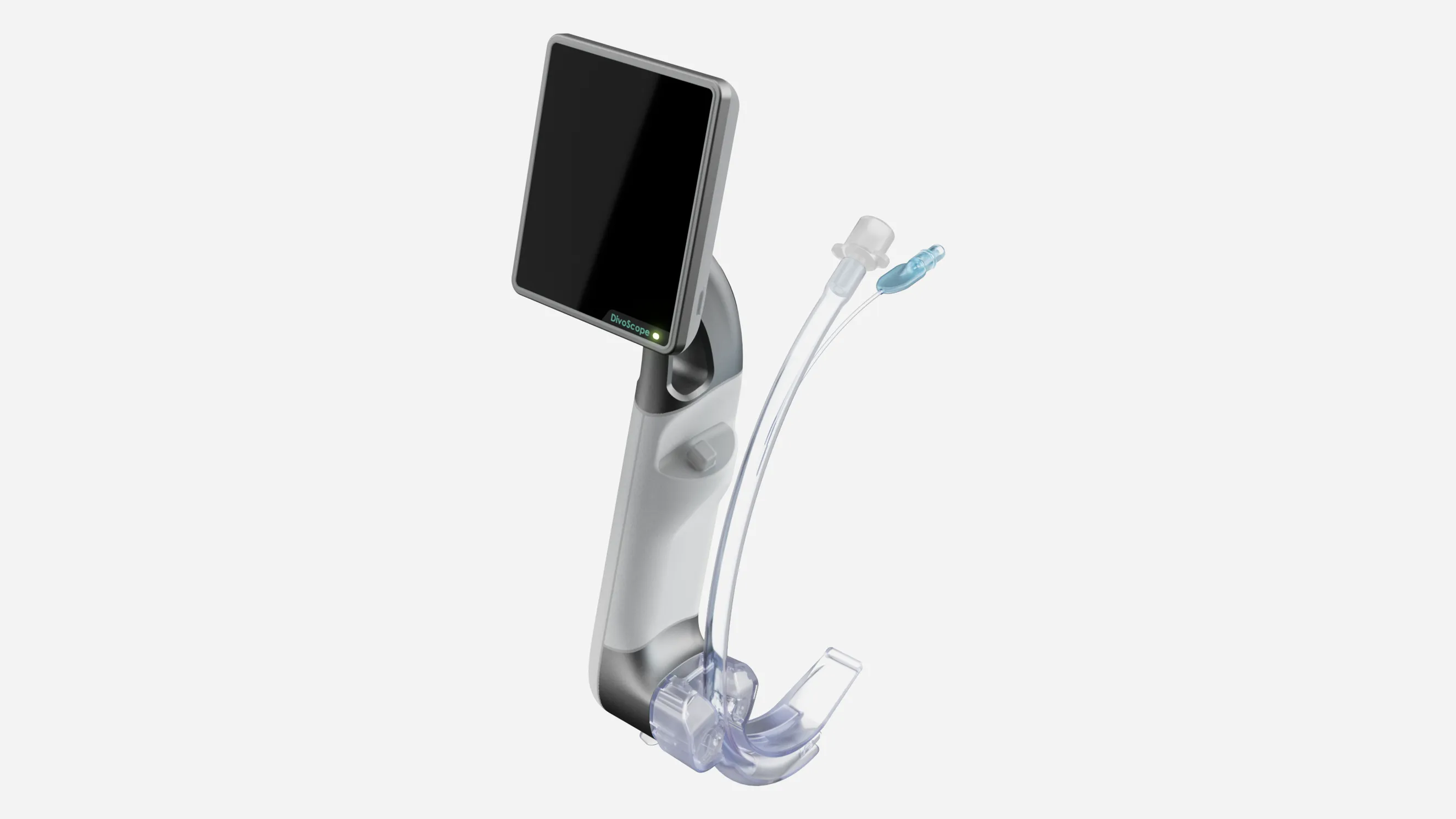
That device is the Divoscope, a videolaryngoscopy system designed from the ground up around a single principle: the technology should carry the complexity so the operator doesn't have to. The Divoscope provides a clear, intuitive view of the airway that guides the user toward correct tube placement, reducing the reliance on years of specialized training and allowing a broader range of clinicians and first responders to perform this critical, life-saving procedure with confidence.
We are at the beginning of our journey, but we see something big. Follow us and contact us if you want to collaborate in this vision.
A Note on Safety
Democratizing intubation does not mean making it casual. Endotracheal intubation carries real risks and no device, however intuitive, eliminates the need for proper training, clear protocols, and an understanding of when and how to perform the procedure. Our vision is not to replace training with technology, but to create technology that makes training more effective and widens the circle of providers who can safely learn and perform this skill. Better tools and better training, together, save more lives.
Pascal Laferriere-Langlois, MD, is a professor of anesthesiology and pain medicine at the Université de Montréal, adjunct professor at McGill University, and co-founder of Divocco, a medical technology company dedicated to advancing airway management. He directs the Laboratory of Artificial Intelligence in Medicine of Montreal (LIAM), where his research focuses on AI-guided videolaryngoscopy and technologies that expand access to critical airway interventions.