
Divoscope Validated in Peer-Reviewed Study | Frontiers in Medicine 2026
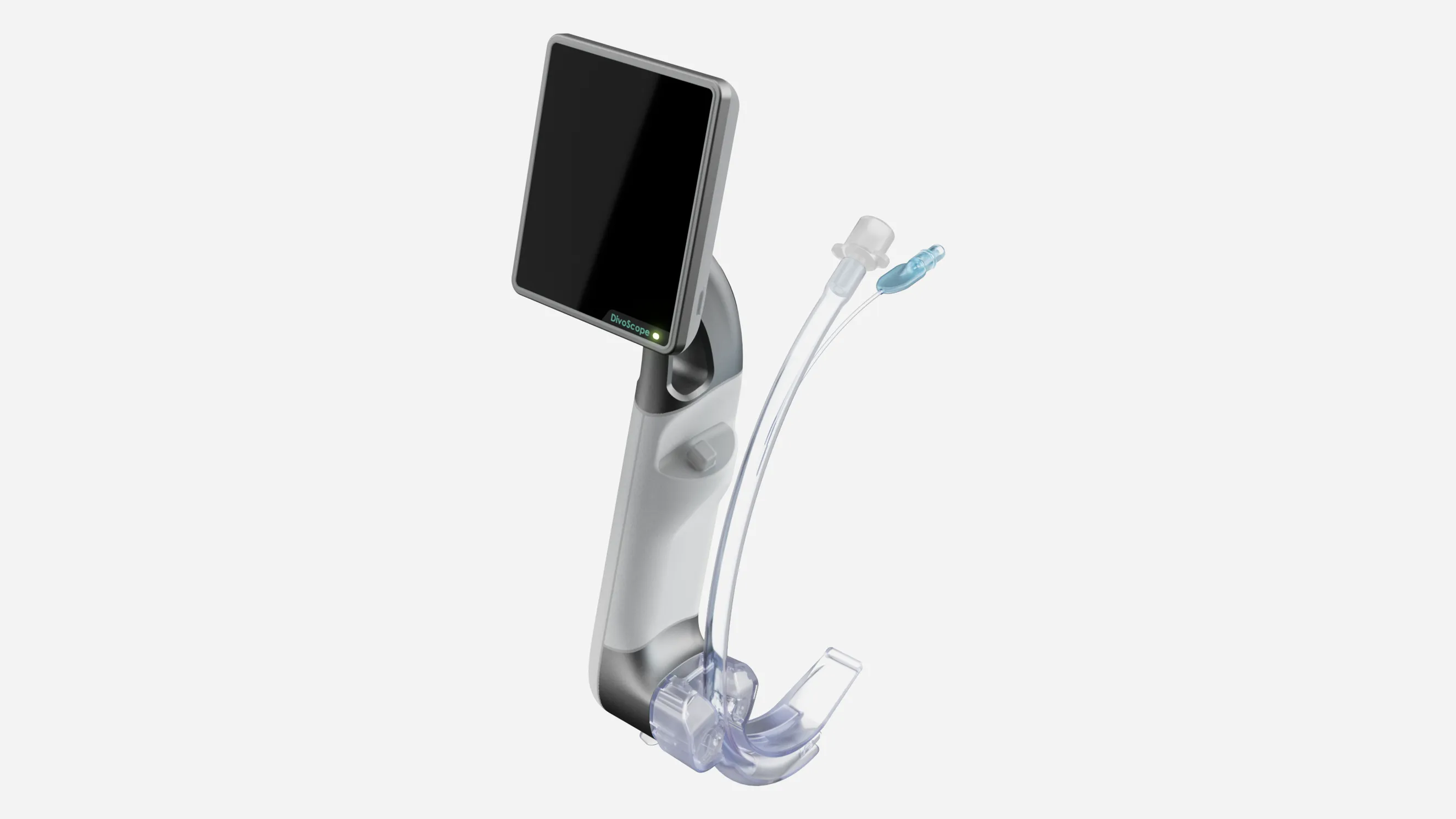
100% — First-attempt success rate
14.3s — Median intubation time
29.1/100 — NASA Task Load Index
What the Study Found
Three operators. Five cadaveric models. Thirty intubations. Zero failures.
The results were unambiguous: a 100% first-attempt success rate, a median intubation time of 14.3 seconds more than 50% faster than conventional videolaryngoscopes and no visible tissue trauma across any of the procedures. Critically, one cadaver presented a restricted mouth opening of just 1.5 cm, one of the most challenging anatomical scenarios in airway management. Performance on that model was consistent with all others.
The Divoscope didn’t just pass the test. It redefined what passing looks like.
Low Workload. High Confidence.
Beyond success rates and timing, the study measured something rarely captured in device validation: how hard it actually feels to use. The weighted NASA Task Load Index score was 29.1 out of 100 placing the Divoscope below the 25th percentile of published medical task norms. Operators rated overall usability at 4.3 out of 5, with a perfect score of 5.0 for training suitability and 4.7 for likelihood of clinical adoption. A device that performs better and feels easier is not an incremental improvement. It is a new category.
Independent. Rigorous. Open-Access.
The study was conducted without commercial funding. Statistical analysis was performed independently. The full publication is open-access and available in its entirety at frontiersin.org because science that saves lives should be accessible to everyone.
« The Divoscope represents a prospective advancement in airway management technology... transforming intubation from a skill-dependent procedure into a more standardized, technology-assisted intervention that could ultimately save lives across the continuum of care. »
Harutyunyan et al., Frontiers in Medicine, 2026
Discover the article here.